Threatening Phone Calls: What to Do When a Caller Threatens You
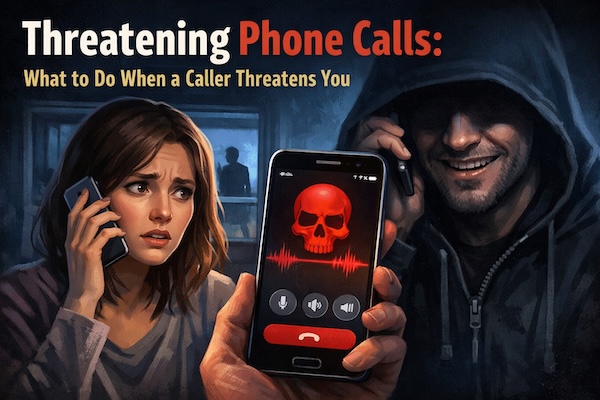
A Step-by-Step Guide to Protect Yourself, Report Extortion, and Regain Your Peace of Mind
The phone rings. You answer, expecting a friend, a family member, or a routine business call. Instead, you are met with a voice that chills you to the core. It might be someone claiming to be from the IRS, saying you owe back taxes and will be arrested. It could be a “debt collector” threatening legal action for a loan you never took. Or perhaps it’s a more direct, sinister threat demanding money or personal information.
In that moment, fear takes over. Your heart races. Your palms sweat. The rational part of your brain shuts down, and the instinct to make the threat go away becomes overwhelming. This is exactly what the person on the other end of the line wants. Every year, thousands of Americans fall victim to extortion phone calls and scam call threats, losing millions of dollars to criminals who exploit this very fear.
This guide is your lifeline. It is designed to walk you, step-by-step, through exactly what to do if you receive threatening phone calls. We will move from the initial panic to concrete actions that protect you, your finances, and your identity. Our goal is not just to inform you, but to empower you. By understanding the scammer’s playbook and having a clear plan, you can turn fear into decisive action and rob these criminals of their power.
The Immediate Response: Regaining Control in the First 60 Seconds
When a threatening caller is on the line, your first reactions are the most critical. They set the stage for everything that follows. The scammer’s entire strategy is built on creating a sense of urgent crisis that bypasses your logical thinking. Your primary job in these first moments is to reclaim that logic.
Step 1: Breathe and Do Not Engage with the Threat
The voice may be yelling. They may be listing dire consequences. They are creating a storm, and your first instinct might be to yell back, to plead, or to try and reason. Do not do this. Take a slow, deep breath. Remember that this is almost certainly a scam. Real government agencies like the IRS or the Social Security Administration do not call and threaten arrest or deportation. Real law enforcement does not operate this way. This simple fact is your anchor.
Do not confirm your name or any other information. Do not answer their questions. Your silence or minimal responses are not an admission of guilt; they are a strategic defense. Simply say, “I do not discuss personal matters on unsolicited calls.” If they claim to be from a specific agency, you can say, “I will contact that agency directly through their official number.” Then, move to the next step.
Step 2: Document Everything Without Them Knowing
While you are on the call, or immediately after hanging up, you must become a detective. Your memory will be clouded by adrenaline, so you need a physical record. If you can do it discreetly, start writing or use your phone’s notes app. If you have a landline, keep a notepad and pen next to it at all times for this very purpose.
Write down the exact time and date of the call. Look at your caller ID and record the number displayed. Be aware that this number is likely "spoofed“ — faked by the scammer to look like a local number or a legitimate government agency number. It is still crucial information. Note the gender of the caller, any accent, their tone, and the exact threats they made. Did they mention a specific agency, a case number, or an amount of money? Write it all down. If you can safely take a screenshot of your caller ID display, do so.
Step 3: Hang Up. It Is Always the Right Move.
There is no prize for being polite to a criminal. There is no obligation to hear them out. Your safety and security are paramount. Once you have gathered the basic information, or if at any point you feel too pressured, simply hang up the phone. You do not need to give a reason. You do not need to say goodbye.
Hanging up is a powerful action. It immediately ends their access to you and stops the psychological assault. It also protects you from the next phase of many scams, where they might try to keep you on the line while an “accomplice” drains your accounts or they pressure you into going to a store to buy gift cards. If it is a real emergency, legitimate authorities will find another way to contact you. In 99.9% of cases, you have just ended a criminal attempt against you.
The Critical Investigation: Identifying the Threat
After you have ended the call, the immediate danger has passed. Now it is time to shift from defense to investigation. Your goal is to answer one question: Was this a known scam or a more serious, targeted threat? The answer will determine your next steps.
This is where technology becomes your best ally. The phone number you recorded, even if it is spoofed, is your first clue. You need to check it against known databases of scam numbers. Websites and apps are built for this exact purpose, leveraging reports from millions of users to create a shield for the community.
Step 4: Check the Number on a Trusted Lookup Service
Immediately take the phone number and enter it into a reliable scam-checking service. One of the most prominent is Truecaller’s free lookup tool. Truecaller maintains a massive global database of numbers reported as spam or “likely fraud” by its over 450 million users. Simply entering the number can instantly tell you if others have received similar threatening calls from it, labeling it as a scam.
Another powerful tool is the Whoscall app, which uses AI and a large community database to identify and block scam calls in real-time, providing caller ID for unknown numbers. For a broader check that includes website scams associated with numbers, you can also use ScamAdviser. If your phone is an Android, you likely already have built-in protection. Go to your Phone app’s Settings and ensure “Caller ID & spam protection” is turned on. This allows Google to identify and warn you about suspected spam callers.
What will this tell you? If the number comes back with multiple reports as “IRS Scam,” “Extortion,” or “Threats,” you have definitive confirmation. This was a mass-market scam call. While frightening, it is not a personal, targeted threat. Your action plan now focuses on reporting and blocking. If the number comes back clean, it does not mean the threat was legitimate — it may be a new number being used by scammers. You will then need to rely more heavily on the nature of the threat itself to decide on further action.
Taking Official Action: Reporting the Threat
Reporting the call is not a futile exercise. It is a vital civic action that helps law enforcement track criminal patterns, shut down operations, and protect others. Your report, combined with thousands of others, creates a map that authorities can follow.
Step 5: Report to the Federal Trade Commission (FTC)
The FTC is the nation’s primary agency for collecting complaints about fraud, including threatening phone scams. Whether you lost money or not, you should file a report. This is the single most important reporting step you can take.
Go to ReportFraud.ftc.gov. The process is straightforward. You will provide the details you diligently recorded: the phone number, the time, the nature of the threat, and what the caller demanded. The FTC analyzes these reports in bulk to identify illegal callers and their patterns. They also release reported numbers to the public daily, which helps phone carriers improve their call-blocking technology. If you did not lose money, you can also use the simpler form at DoNotCall.gov.
Step 6: When to Contact Local Law Enforcement
For the vast majority of scam calls, your report to the FTC is sufficient. However, there are specific circumstances where you should also file a report with your local police department.
Contact the police if the threat involves immediate physical violence or harm to you or your family, and you believe it may be credible (e.g., the caller knows your specific address, describes your vehicle, or names family members). Also report if the scammer has successfully extracted money from you via a method like a wire transfer or gift cards, as this constitutes theft. When you file the report, bring all your documentation — your notes, the phone number, and any confirmation from lookup services. This creates an official record, which can be crucial for insurance claims or if the harassment escalates.
Remember, scammers often impersonate local law enforcement as part of their ruse. If you are unsure, you can always call the non-emergency line for your local police department to verify if the threat is real. They will tell you if they are trying to contact you.
Fortifying Your Defenses: How to Block and Prevent Future Calls
After dealing with the immediate threat and reporting it, your final step is to build a stronger defense for the future. Scammers are persistent, and you may be targeted again by the same or different groups. Fortunately, you have powerful tools at your disposal.
Step 7: Block the Number on Your Phone
The method for blocking a number depends on your type of phone. On most smartphones, you can go to your recent call list, tap the offending number, and select “Block” or “Report as Spam.” This prevents that specific number from ringing your phone again. On iPhones, this is found under the information (i) icon next to the number. On Android phones with Google’s Phone app, you can tap the number in your call history and select “Block/report spam”.
For traditional landlines, your options include asking your phone provider about call-blocking services or purchasing a call-blocking device that you attach to your phone. These devices can use databases of known scam numbers and allow you to create your own block list.
Step 8: Employ Advanced Call-Blocking Technology
Since scammers constantly change (spoof) their numbers, blocking one is often not enough. You need a proactive filter. The best way to do this on a cell phone is to use a call-blocking app. These apps act as a sieve, using vast databases and community reports to identify and intercept scam calls before your phone even rings.
Your phone carrier may offer a service, often called “Call Protect” or similar. Contact them or check their website. You can also download a dedicated app. The FTC recommends checking expert reviews and looking at lists provided by the wireless industry. Apps like Truecaller and Whoscall, mentioned earlier, provide this real-time blocking as part of their service. Many are free for basic protection.
Step 9: Register on the National Do Not Call Registry
While scammers blatantly ignore the law, you should still add your number to the National Do Not Call Registry. This free service is designed to stop sales calls from legitimate telemarketing companies. Registering your home or mobile number won’t stop criminal scammers, but it will drastically reduce the number of legal sales calls you get. This makes the threatening, illegal scam calls much more obvious and easier to identify when they do come through.
Special Scenarios: What If You Already Paid or Gave Information?
If the scam was successful and you paid money or gave out personal information in the heat of the moment, do not despair. Acting quickly is key to mitigating the damage. This is a more serious situation, but you still have clear steps to follow.
If You Paid the Scammer
Your recovery path depends entirely on how you paid. You must act immediately. If you paid with a credit or debit card, contact your bank or card issuer right now. Report it as a fraudulent transaction and ask them to reverse the charge. If you sent money via a wire transfer service like Western Union or MoneyGram, call their fraud hotlines immediately (Western Union:
Scammers love gift cards, wire transfers, and cryptocurrency because they are like sending cash — hard to trace and nearly impossible to reverse. The sooner you act, the slimmer chance you have of stopping the transfer or getting your money back.
If You Gave Out Personal Information
If you revealed your Social Security number, go to the government’s official resource, IdentityTheft.gov, immediately. This site, run by the FTC, will create a personalized recovery plan for you. It will guide you through placing fraud alerts on your credit, getting free credit reports, and closing any accounts opened fraudulently in your name.
If you gave out usernames and passwords, change those passwords instantly. If you use the same password on any other site, change those as well. Enable two-factor authentication wherever possible for an extra layer of security.
A final, crucial warning: Be wary of “recovery scams.” After you report a loss, new scammers may call you, posing as law enforcement or a recovery service, claiming they can get your money back for a fee. This is another lie. No legitimate agency will ever ask you to pay to get your own money back.
Empowerment Over Fear: Your New Mindset
Receiving a threatening phone call is a violation. It can leave you feeling vulnerable and anxious long after you hang up. The final step in this guide is mental and emotional. You must replace the scammer’s narrative of fear with your own narrative of control.
You now have knowledge. You know that real government agencies do not operate by threat and intimidation over the phone. You know the hallmarks of a scam: urgency, specific payment demands (gift cards, wire transfers), and spoofed numbers. You have a plan: Hang up, Document, Check, Report, Block.
Share this knowledge with your family, especially elderly relatives who are often targeted. Talk to your friends. Make a pact to never feel pressured by an unsolicited call again. By understanding how to report threatening calls and taking action, you are not just a potential victim; you are an active participant in fighting back against these criminals. You are taking your power back.